

Anti-Whites On The Run! Trump Team Takes ACTION
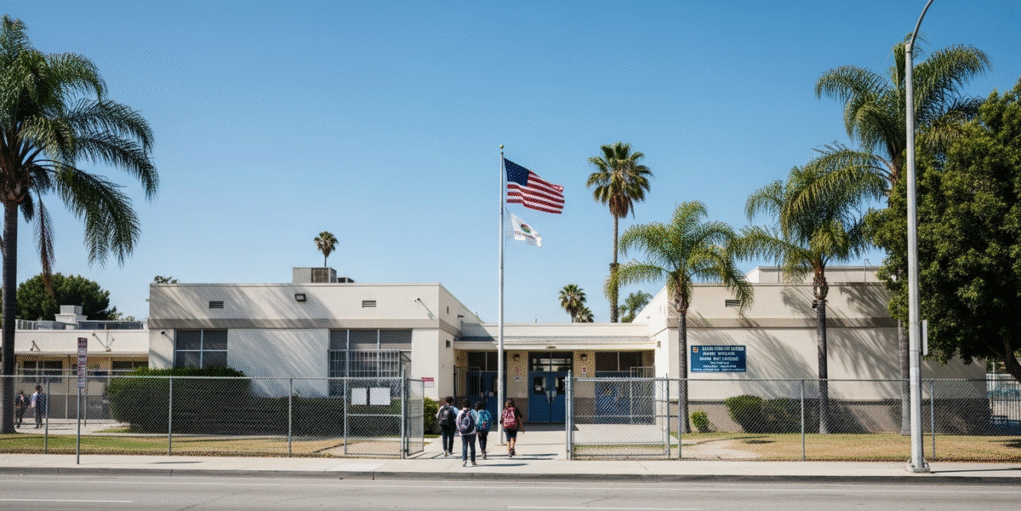
The Los Angeles Unified School District has a program. It’s called PHBAO — Predominantly Hispanic, Black, Asian, and Other. The name alone tells you everything. There’s a category for every race in America except one. White kids aren’t “predominantly” anything in this system. They’re the baseline against which disadvantage is measured.
Here’s how it works. LAUSD classifies neighborhoods as either “Anglo” or non-Anglo. If a neighborhood has fewer than 30% white residents, the schools in that neighborhood are labeled “disadvantaged.” Those schools get extra funding to reduce class sizes by 5.5 students per teacher. Their students receive admission preferences for competitive magnet programs.
The classification isn’t based on income. It isn’t based on test scores. It isn’t based on any measure of actual educational need. It’s based on race. Specifically, the percentage of white people in the neighborhood. Below 30% white? Disadvantaged. Above 30%? Not disadvantaged. That’s the formula. That’s been the formula for sixty years.
The Department of Justice just intervened to stop it.
The Lawsuit
The 1776 Project Foundation, a conservative education nonprofit, filed the original lawsuit in January. Lead attorney Michael DiNardo laid out the case plainly: “These policies are not just unfair — they’re unconstitutional. What began as a temporary measure to address segregation has become a rigid system of racial favoritism that excludes thousands of students from equal opportunity.”
Temporary measure. That’s the key phrase. The PHBAO program was created during the desegregation era as a tool to address the legacy of racial segregation in Los Angeles schools. It was supposed to be transitional — a bridge to a system where resources were distributed based on need, not race.
Sixty years later, the bridge became the road. The temporary program became permanent policy. And a classification system designed for a city that was majority white became absurd in a district where white students now make up approximately 10% of total enrollment.
Ten percent. White students are a single-digit minority in LAUSD. And the system still classifies neighborhoods by how many white people live there — as if whiteness is the only variable that determines educational advantage.
The Scale
The PHBAO label covers more than 600 LAUSD campuses. Fewer than 100 schools fall outside the classification. That means the vast majority of the district is labeled “disadvantaged” based on racial composition — regardless of the actual economic circumstances of the families served.
A wealthy neighborhood with expensive homes and high-earning families gets the “disadvantaged” label if fewer than 30% of residents are white. A struggling neighborhood with high poverty and low test scores doesn’t get the label if it happens to have 31% white residents.
The system doesn’t measure disadvantage. It measures melanin. And it’s been doing it for six decades while nobody in the Los Angeles political establishment had the courage or the incentive to stop it.
The DOJ Intervention
Attorney General Pam Bondi: “Treating Americans equally is not a suggestion — it is a core constitutional guarantee that educational institutions must follow.”
Assistant AG Harmeet Dhillon: “Los Angeles County students should never be classified or treated differently because of their race. Yet this school district is doing exactly that by providing benefits that treat students — based on their race — as though they have learning disabilities.”
That last line deserves emphasis. The PHBAO system doesn’t just allocate extra money to certain schools. It treats non-white students as if their race itself is a learning disability — as if the presence of fewer white neighbors creates an educational deficit that requires compensatory resources. That’s not anti-racism. That’s racism with a funding formula.
First Assistant U.S. Attorney Bill Essayli put it in historical context: “Now in its sixth decade, LAUSD’s desegregation program has outlived its usefulness to the point of being unconstitutional. School districts must treat their students equally and no longer discriminate on the basis of race.”
The Absurdity of “Anglo” Classification
LAUSD’s classification system uses the word “Anglo.” In 2026. In a city that is roughly 48% Hispanic, 11% Black, 11% Asian, and 10% white. The district is labeling neighborhoods based on a demographic category that represents a tenth of its student population — as if the presence or absence of white students is the defining characteristic of educational quality.
This made some marginal sense in the 1960s, when Los Angeles was majority white and school segregation was a product of housing policies that concentrated minority students in under-resourced schools. It makes zero sense today, when white students are a small minority and the district’s challenges — overcrowding, underfunding, achievement gaps — have nothing to do with the racial composition of neighborhoods and everything to do with poverty, immigration, language barriers, and structural dysfunction.
The system is a relic. But relics in government don’t die. They accumulate constituencies. They generate funding streams. They create bureaucratic positions. And they become politically untouchable because anyone who questions them gets accused of opposing the original mission — in this case, desegregation.
That’s how a temporary program survives for sixty years past its expiration date. Not because it works. Because dismantling it is politically dangerous.
What Comes Next
LAUSD’s spokesperson offered the standard non-response: the district “remains firmly committed to ensuring all students have meaningful access to services and enriching educational opportunities.” Translation: we’re not changing anything voluntarily.
The DOJ intervention changes the calculus. This is no longer a private lawsuit that the district can outlast through procedural delays. The federal government is now a party to the case, with the resources and authority to force compliance. The Civil Rights Division — under Dhillon’s leadership — has made clear that racial classification systems in education are a priority target.
The 14th Amendment guarantees equal protection under the law. It doesn’t say equal protection unless the classification has been in place for sixty years. It doesn’t say equal protection unless the beneficiaries are non-white. It says equal. Period.
LAUSD has been violating that principle for six decades. The DOJ just showed up to enforce it. And for the first time since the program was created, the students who’ve been classified by the color of their skin instead of the content of their character might finally get the equal treatment the Constitution promised them all along.